Industry Insights
Certitude’s Product Management Capability
Certitude’s Product Management Capability
Daniel Luschwitz, Principal
One of the most persistent problems I see in organisations trying to modernise is the conflation of project management and product management. On the surface they look similar with teams delivering to timelines. But the underlying logic is fundamentally different, and confusing one for the other can quietly undo years of good work.
I saw it recently. An organisation had product teams structured around value streams, built meaningful metrics, and had real delivery momentum. Then an incoming manager ran a P3M3 assessment, not for any sinister motive, it was just what he was used to. The result was that the language changed, governance tightened around outputs, and teams that had been empowered to own problems started waiting for sign-off. A genuine delivery engine reverted to siloes, not because the people changed, but because the operating model did.
There is absolutely room for both project management and product management disciplines in a modern organisation. The question isn’t which one is better, it’s what are you actually trying to optimise for, and are your governance, metrics, and ways of working aligned to that goal? The organisations that struggle are the ones that haven’t been deliberate about which model applies where, and why.
This is the heart of what we’ve always believed at Certitude: start with context. We offer P3M3 assessments, and they’re a powerful tool in the right situation. But if you came to us wanting to understand your product delivery maturity, we wouldn’t prescribe one.
I joined Certitude to help build out a new practice, drawing on my background working with organisations running large development capabilities managing digital transformation. To start this journey, I did what any good product manager would do – talk to as many customers as possible, listening for the pain points and understanding what was actually getting in the way.
What I found was that the same terms mean different things in different organisations, and the heart of this confusion was the operating model context. That insight became a core design principle. Rather than prescribe a single methodology, we focused on helping organisations understand their context first, then building capability that actually fits.
So, what have we launched?
We’ve developed a whitepaper on the Product Operating Model, a framework of seven interconnected pillars that separates organisations optimised for outcomes from those still running on project logic. It’s practical, grounded in evidence, and provides context to the operating model that supports product capabilities. This is a good place to start.
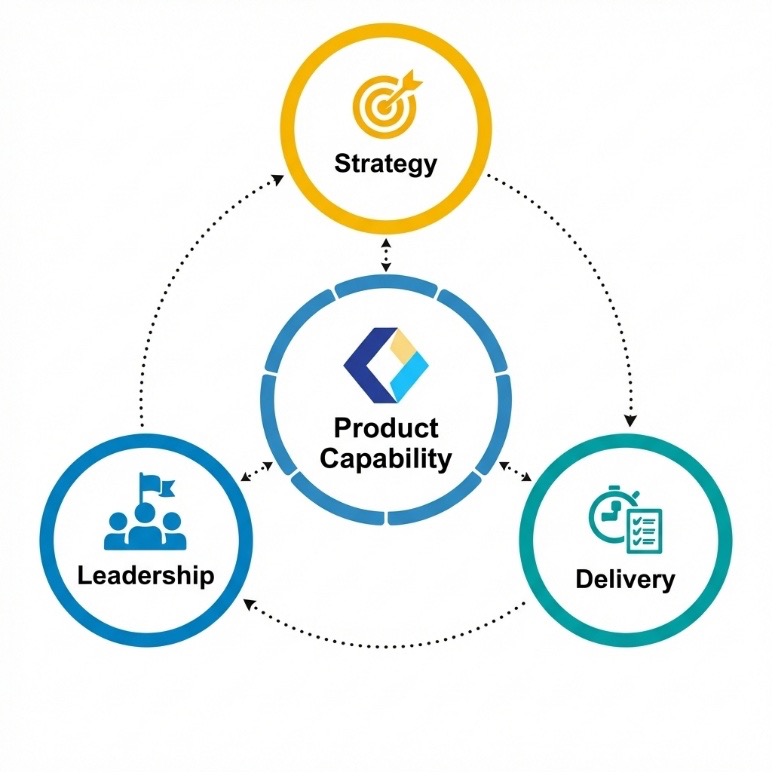
We’ve built three core learning programs covering Product Strategy, Product Leadership, and Product Delivery, designed to build capability at every layer of an organisation, optimising around product delivery.
And the piece I’m most excited about, we’ve partnered with the Collab Group to bring Cowtopia to Australia. It’s a product thinking simulation, and it’s a little out of the ordinary in the best possible way. I’ve worked with the co-creator Michael Ong for years and seen firsthand the shifts it creates in teams. It’s one thing to teach product thinking. It’s another to let people experience it, make decisions, see consequences, and build genuine instinct.
What we’ve launched isn’t a methodology imported from someone else’s playbook. It’s a capability built on years of working with Australian organisations, shaped by what we’ve seen work and what we’ve seen quietly fail. If any of this resonates, I’d love to have a conversation starting with your context. We always do.