Industry Insights
Benefits realisation isn’t a Program Management artefact. It’s time we stopped treating it like one | Chris Blunt

Most organisations I speak with have a benefits plan.
It sits inside program management framework. It gets signed off as part of the business case. It names a benefit owner. It describes how value will be measured. And then once the program moves into delivery it quietly recedes into the background. It surfaces briefly at stage gates. And then again, much later, when someone finally asks for the post-implementation review.
By that point, the program team has moved on. The sponsor has a new priority. The benefit owner named in the document has often changed roles and the connection between what was promised to the organisation and what actually happened in operations is, at best, difficult to reconstruct.
This is more and more commonly the norm and its increasingly not compliant.
The policy framework has moved on. Many organisations haven’t.
In October 2025, the Australian Government introduced the Benefits Management Policy (BMP) — a whole-of-government standard that puts benefits at the centre of how digital and ICT investments are planned, prioritised, governed and evaluated. The policy is explicit: benefits management must remain a key focus throughout implementation, not just at business case approval. Agencies are required to define how improvements will be measured and monitored. Clear ownership of each benefit is mandatory not recommended.
This sits within a broader investment oversight framework that the OECD, in its 2025 Digital Government in Australia report, described as providing a “comprehensive, end-to-end approach across the digital investment lifecycle.. from early planning to benefit realisation.” The Digital Transformation Agency’s own framing echoes this directly: the Investment Oversight Framework (IOF) “applies from early planning through to delivery and realisation of planned benefits.”¹
The policy intent is unambiguous. Benefits realisation is not a program deliverable. It is a continuous organisational accountability that spans the full investment lifecycle.
The question is whether most organisations, in government and in the private sector, are actually set up to honour that accountability. In my experience, most are not.
The structural problem: benefits management is embedded in the wrong place.

The root of the problem is architectural.
In the standard delivery model, the benefits plan lives inside the program framework. It is owned by the program. It is governed at this level. And when the programme wraps up, it is handed over to whoever is receiving it along with the other artefacts: the lessons learned register, the risk closure report, the system documentation.
The handover is rarely successful. Not because people don’t try, but because the receiving function — whether that’s operations, a programme management office, or a nominated business owner — was never designed to carry this responsibility. They didn’t build the plan. They often don’t fully understand the baseline. They have no ongoing governance mechanism to track performance against it and they have competing operational priorities from day one.
So the benefits plan, carefully constructed during business case development, sits in a SharePoint folder and is rarely opened again.
The deeper issue is that this model treats benefits as something that happens within the delivery boundary, when in reality it needs to sit above it.
Benefits are not a program outcome. They are an organisational outcome.
They are the reason the investment was approved. They connect directly to the strategic objectives the organisation was trying to advance when it decided to spend the money. And they can only be properly governed by a function that is accountable to strategy not to delivery.
What most frameworks get right, and what they miss.
To be fair, most mature program management frameworks do acknowledge this problem.
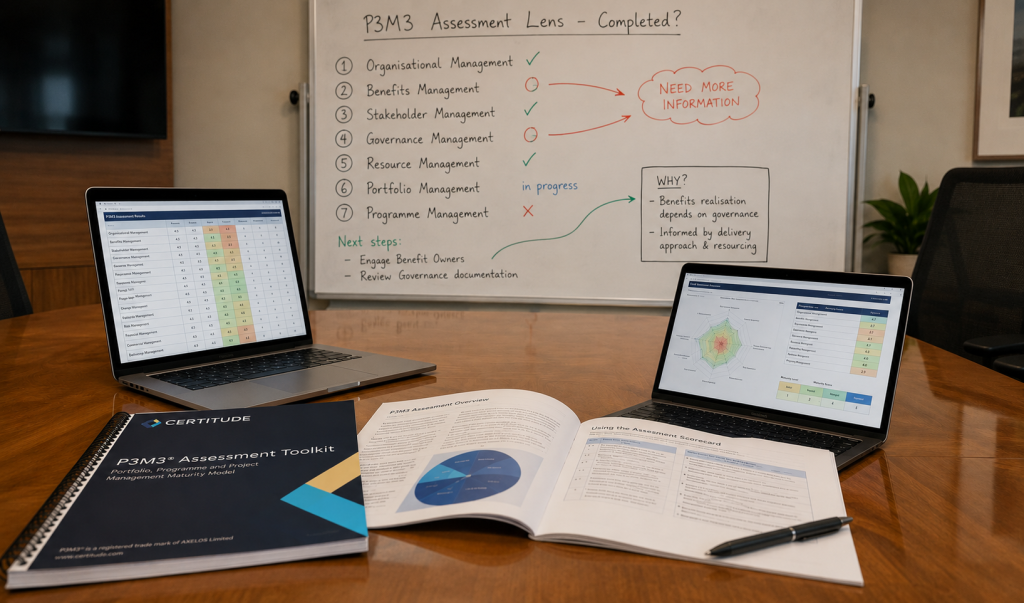
PRINCE2, Managing Successful Programmes (MSP), and the broader Portfolio, Programme and Project Management Maturity Model (P3M3) all include benefits management as a discipline. The guidance is sound: benefit ownership should persist beyond program closure, baselines need to be established early, and realisation needs to be tracked through a defined period of operations.
But knowing the framework is not the same as having the organisational structure to carry it. In practice, the gap between what these frameworks describe and what organisations actually implement is significant and it is almost always structural, not technical.
The most common failure mode is not ignorance of the framework. It is the absence of a function that sits above the delivery layer with explicit accountability for benefit realisation across the portfolio.
In government terms, this is the role of the Enterprise Project Management Office (EPMO) or investment governance function at its most mature. In the private sector, it tends to sit, if it sits anywhere with the strategy or finance function. Where it lands matters: a finance-owned function tends to track costs and savings; a strategy-owned function tracks whether the investment is advancing the organisation’s actual objectives. The two are not the same.
In many organisations, it doesn’t sit anywhere at all. The PMO governs delivery. The business case governance function approves investments. And no one is accountable for tracking whether the anticipated value was actually delivered.
What good looks like: benefits management as a strategic function.
If benefits management is to work, really genuinely work, not just comply with a policy requirement — it needs to be reconceived as a strategic function rather than a program artefact.
What does that mean in practice?
Benefits governance sits above the delivery layer. The benefits realisation framework is not owned by the program. It is owned by the function accountable to organisational strategy i.e. the EPMO, the investment governance board, or the equivalent. Programs contribute to it. They don’t contain it.
Benefit owners are accountable to strategy, not delivery. Naming a benefit owner in a business case is necessary but not sufficient. That person needs a direct line to the strategic objective the investment is intended to advance, the authority to raise concerns when the delivery trajectory is diverging from the expected value path, and a governance forum that takes their reporting seriously.
The baseline is established before delivery begins. One of the most consistent failures in benefits management is the absence of a credible baseline. If you can’t describe the current state in actual measurable terms before the investment starts, you have no basis for demonstrating realisation afterwards. Establishing the baseline is not a program activity that can be deferred. It is a precondition for accountable investment governance.
Post-implementation monitoring is designed in from the start. The Digital Performance Standard’s Criterion 5 requires agencies to establish internal processes to collect, analyse and interpret performance data and to act on any improvements identified. That kind of ongoing monitoring capability doesn’t emerge spontaneously at go-live. It needs to be designed, resourced and owned before the program closes which means the conversation needs to happen during delivery, not after it.
The benefits realisation plan connects explicitly to strategic objectives. A benefits plan that lists efficiency gains and cost savings without connecting them to the strategic outcomes they serve an accounting exercise, not a governance tool. The link between individual investment benefits and portfolio-level strategic value needs to be explicit, maintained, and visible to decision-makers.
The uncomfortable question for programme leaders.
How many of your current investments have a named benefit owner who is actively monitoring realisation not just named in a document?
How many have a baseline that was established before delivery started and is being tracked against today?
How many will have a functioning post-implementation monitoring process in place at go-live — not a plan to establish one, but an actual process with ownership and reporting?
And how many will have a benefits realisation story that is coherent, credible and connected to your strategic objectives at six months post-launch?
The Australian Government’s Benefits Management Policy and the OECD’s end-to-end investment oversight framing set a standard that many organisations, government and private sector alike, are not yet meeting. But more importantly, they describe a standard of investment governance that is simply more likely to produce the outcomes organisations are investing to achieve.
Benefits management that lives above the delivery layer, connects to strategy and persists through operations is not a compliance response. It is what accountable investment governance actually looks like.
If this resonates with where your organisation is right now.
I work with government agencies and large organisations through Certitude to review and redesign the governance structures, capability frameworks and programme management disciplines that make benefit realisation sustainable, not a program deliverable that gets handed over and forgotten.
Certitude has worked with 15+ federal agencies, 30+ state agencies and 50+ councils on exactly these kinds of structural capability challenges.
If your programme governance model needs a structural review or if you’re building an investment oversight capability and want to get the architecture right from the start get in touch directly or reach the Certitude team below.
References
¹ OECD (2025), Digital Government in Australia, OECD Publishing, Paris. Available at: https://www.oecd.org/en/publications/digital-government-in-australia_91c22326-en.html
² Digital Transformation Agency, Digital and ICT Investment Oversight Framework, digital.gov.au. Available at: https://www.digital.gov.au/investment
Other articles of interest
Project, Program Maturity: the Level 2 to Level 3 Shift | Certitude Australia